

How to Calculate Service Prices and Profit Margins
Learn how to calculate the true cost of a service, set a price for your target profit margin, and review supplies and expenses by location.
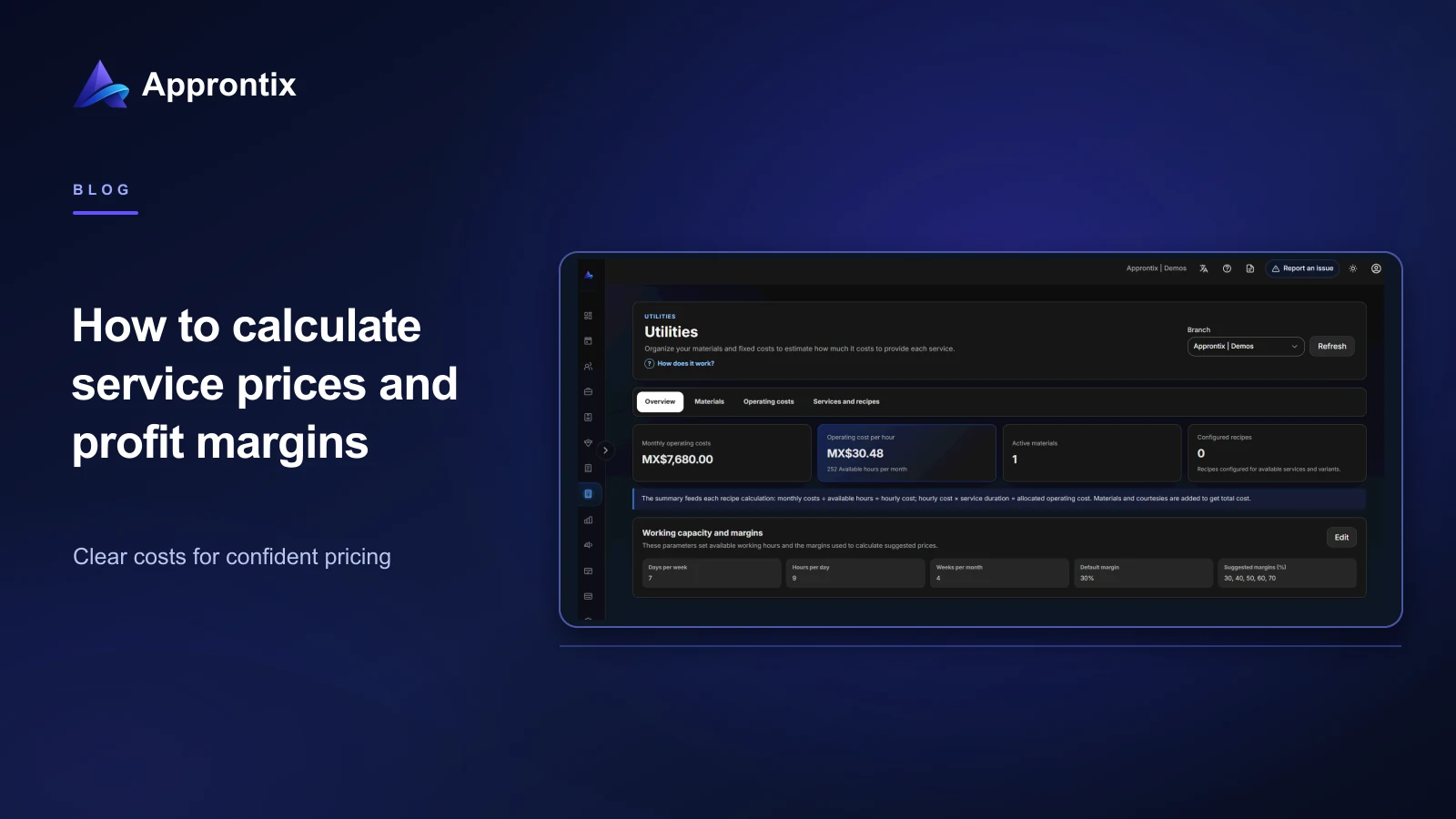
To price a service, first calculate what it costs to deliver, then decide what profit margin you want. Adding a percentage to your cost does not always produce the margin you expect: margin is calculated from the selling price. A service cost calculator helps you bring supplies and operating costs together, estimate profit, and compare suggested prices before updating your service menu.
This guide is for barbershops, salons, spas, clinics, and other businesses that charge for services. In Approntix, the Utilities calculator lets you track supplies and operating costs by location, create a recipe for each service, and review costs, profit, and suggested prices. You can pair that information with organized service management.
What you need to calculate the cost of a service
Start with the resources that are actually used or allocated when delivering the service:
- Supplies: products, disposable materials, and other consumables used for each appointment.
- Operating costs: expenses you want to include in the calculation, such as rent, utilities, or maintenance. Choose a reasonable method for allocating them across services.
- Quantity used: how much of each supply one appointment requires, not just what you paid for the full container.
- Location: track cost differences when you buy supplies or provide the same service at different locations.
A service recipe connects supplies to a specific appointment. For example, if a product costs $300 MXN for 1,000 ml and you use 30 ml, the product cost for that service is $9 MXN. Repeat this for each supply, then add the operating costs you allocate to get the estimated total cost.
How to calculate a price for your target profit margin
Use these two formulas:
Profit margin (%) = (selling price − total cost) ÷ selling price × 100
Target price = total cost ÷ (1 − target margin)
Suppose it costs $180 MXN to deliver a service and you want a 40% margin. The target price is $180 ÷ (1 − 0.40) = $300 MXN. Profit before any costs not included in your calculation would be $120 MXN, or 40% of the price.
By comparison, adding 40% to the $180 cost gives a price of $252. The profit would be $72, but the margin on that price would be about 28.6%. Understanding the difference between margin and markup helps you avoid pricing below your financial target.
What a suggested price means
A suggested price is a starting point calculated from the costs and margin you set. It does not guarantee profitability or require you to charge that exact amount. Before adopting it, check whether the calculation includes all relevant expenses and whether the price makes sense for your customers and market.
Also consider service duration, booking capacity, expertise, taxes, payment fees, and any costs you have not yet included. Do not count an expense twice if it is already part of another input. Costs and prices can vary by location, so review each one separately.
Steps to review your prices
- Track supplies and operating costs. Use current costs and clear units, such as price per milliliter or per item.
- Create a recipe for each service. Record the supplies and quantities used in a typical appointment.
- Review total cost by location. Update quantities, recent purchases, and expenses that have changed.
- Set your target margin. Distinguish a margin calculated from the selling price from a percentage simply added to cost.
- Compare the suggested price with your market. Consider duration, demand, capacity, positioning, and comparable alternatives.
- Update and review again. Recalculate when supplies, rent, fees, or other important costs change.
The Approntix Utilities calculator brings together supplies and operating costs by location and shows cost, profit, and a suggested price for each service. Use it to support clearer decisions; review the assumptions and recorded information before changing what you charge.
Frequently asked questions
How do I calculate the profit margin for a service?
Subtract total cost from the selling price, divide the result by the selling price, and multiply by 100. If a service costs $180 and sells for $300, the margin is ($300 − $180) ÷ $300 × 100 = 40%.
What is the difference between margin and markup?
Margin expresses profit as a percentage of the selling price. Markup expresses how much you added to cost. With a cost of $180, adding 40% gives a $252 price and a margin of about 28.6%, not 40%.
What costs should I include when pricing a service?
Include the supplies used and a reasonable share of the operating costs you want to allocate to the service. Depending on your business, also consider fees, taxes, and other relevant costs. Use a consistent method to compare services and locations.
Does a pricing calculator guarantee that a service will be profitable?
No. The result depends on complete, current costs, quantities, and assumptions. You also need to check that the price works for your customers and that your operation can deliver the service at the expected quality and time.
Why calculate costs by location?
Supplies and expenses can vary between locations. Keeping the information separate helps prevent a price based on one location’s costs from being applied to another without review.