

How to reduce appointment no-shows: a practical guide
Reduce missed appointments with clear confirmations, timely reminders, and a policy that respects both your clients and your team.
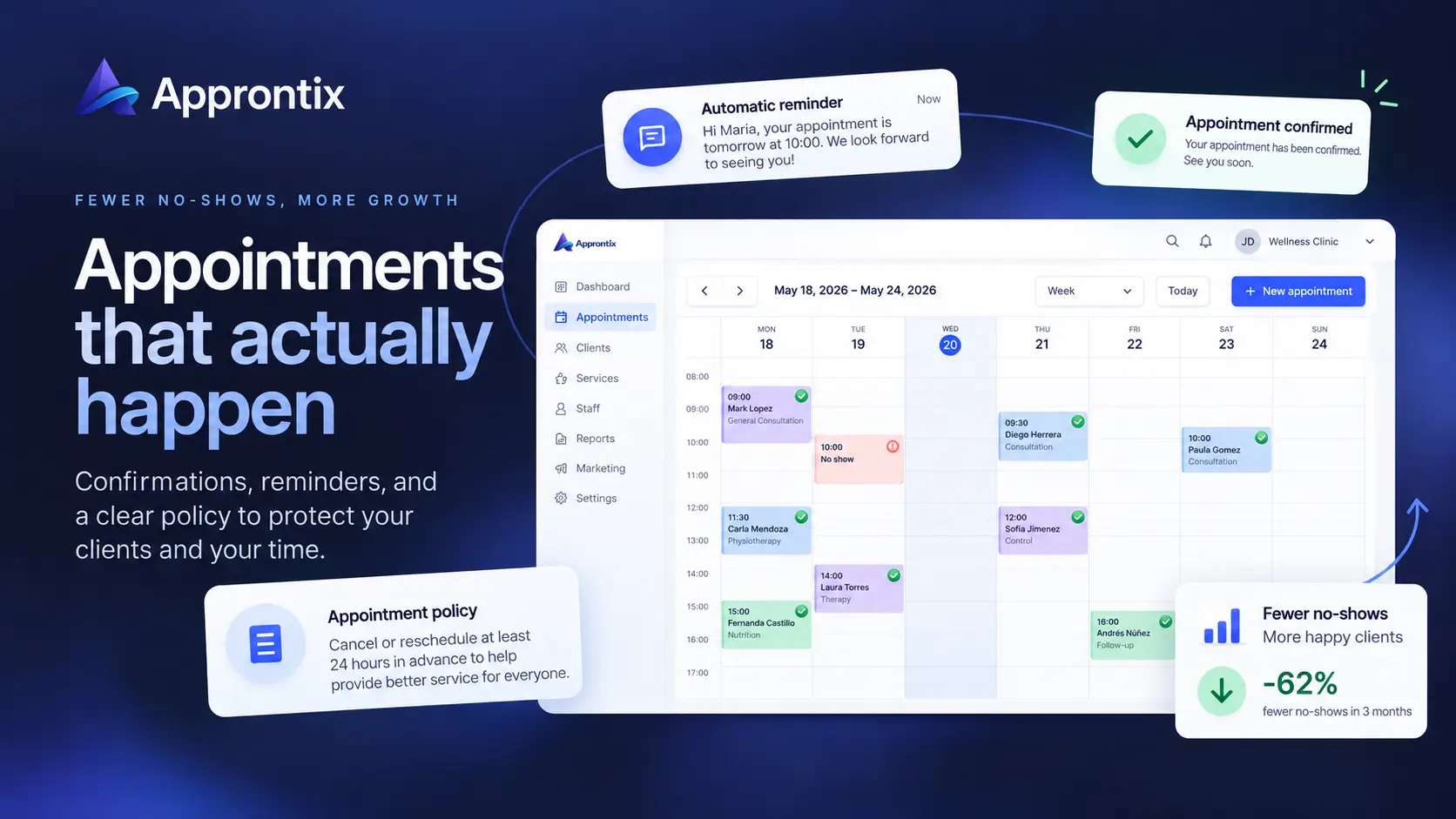
An appointment no-show happens when a customer reserves a slot but does not attend or cancel in time. For a service business, that is more than a minor inconvenience: the slot could have gone to someone else, team time goes unused, and the day becomes harder to plan.
Reducing no-shows does not mean chasing every client. It means building a clear process from the moment they book until they arrive.
Find the reason before changing the rules
Track missed appointments for a few weeks. Are they mostly new customers, a certain service, early appointments, or bookings made far in advance? Common reasons are simple: people forget, did not receive a confirmation, cannot easily reschedule, or have no commitment to the reservation.
Separating those cases helps you choose an appropriate response instead of applying the same rule to everyone.
Confirm the important details immediately
Every booking should clearly state the service, date, time, location or format, and the person delivering the service when relevant. A brief confirmation avoids misunderstandings and gives customers a chance to spot a mistake before the appointment day.
Include a visible way to confirm, cancel, or request a change. When moving a booking is difficult, people are more likely to simply not show up.
Send reminders when customers can act on them
A useful sequence is an immediate confirmation, a reminder 24 to 48 hours before the appointment, and—when appropriate—a final message on the same day. The right channel depends on your customers; email, SMS, and WhatsApp can all work.
What matters is consistency. Reminders should not depend on someone on the team remembering to send them manually. Approntix features bring scheduling together with WhatsApp notifications so appointment communication stays part of the operation.
Set a clear cancellation policy
Your policy should explain how much notice customers need to cancel or move a booking and what happens when they do not. Show it before the reservation is confirmed and repeat it in key reminders. Plain language works better than a threatening tone.
For services that require a deposit, explain whether it can be applied to a new date or when it is not refundable. Consistency matters more than creating a harsh policy.
Use deposits selectively
Deposits are useful for long services, high-demand hours, work that needs materials prepared in advance, or repeat no-shows. A proportionate amount can create commitment without becoming a barrier to booking.
Keep the payment status connected to the booking. With online bookings and payments, the schedule, payment, and client context stay in one operational workflow rather than scattered across messages.
Measure the result
Start with a simple rate: missed appointments divided by booked appointments, reviewed monthly. Compare it by service, booking channel, or customer type. Also look at reschedules; fewer no-shows with more reschedules can be a positive outcome because the slot was not lost.
The goal is not zero no-shows at any cost. It is protecting your team’s time while keeping the experience straightforward for responsible customers.
Frequently asked questions
How far in advance should I send an appointment reminder?
For many services, 24 to 48 hours gives customers enough time to confirm or move the booking. A same-day reminder can help for important or difficult-to-replace appointments.
Do deposits upset customers?
They can if they appear unexpectedly. Explain their purpose, use them where they make sense, and make the rescheduling policy clear so they are seen as a time reservation rather than a penalty.
What should I do about repeat no-shows?
First verify that the customer received the right communications. If the pattern continues, set a reasonable condition for future bookings, such as a deposit, and state it before confirming the new appointment.